Software Engineering Essentials
CS846 Machine Learning for Software Engineering — Spring 2026
Pengyu Nie
Agenda
- Goals
- review key concepts in SE from data-driven view
- pointers to tools and datasets
- breath; relevancy; recency
- No-Goals
- depth; completeness
Overview (Software Development Life Cycle)
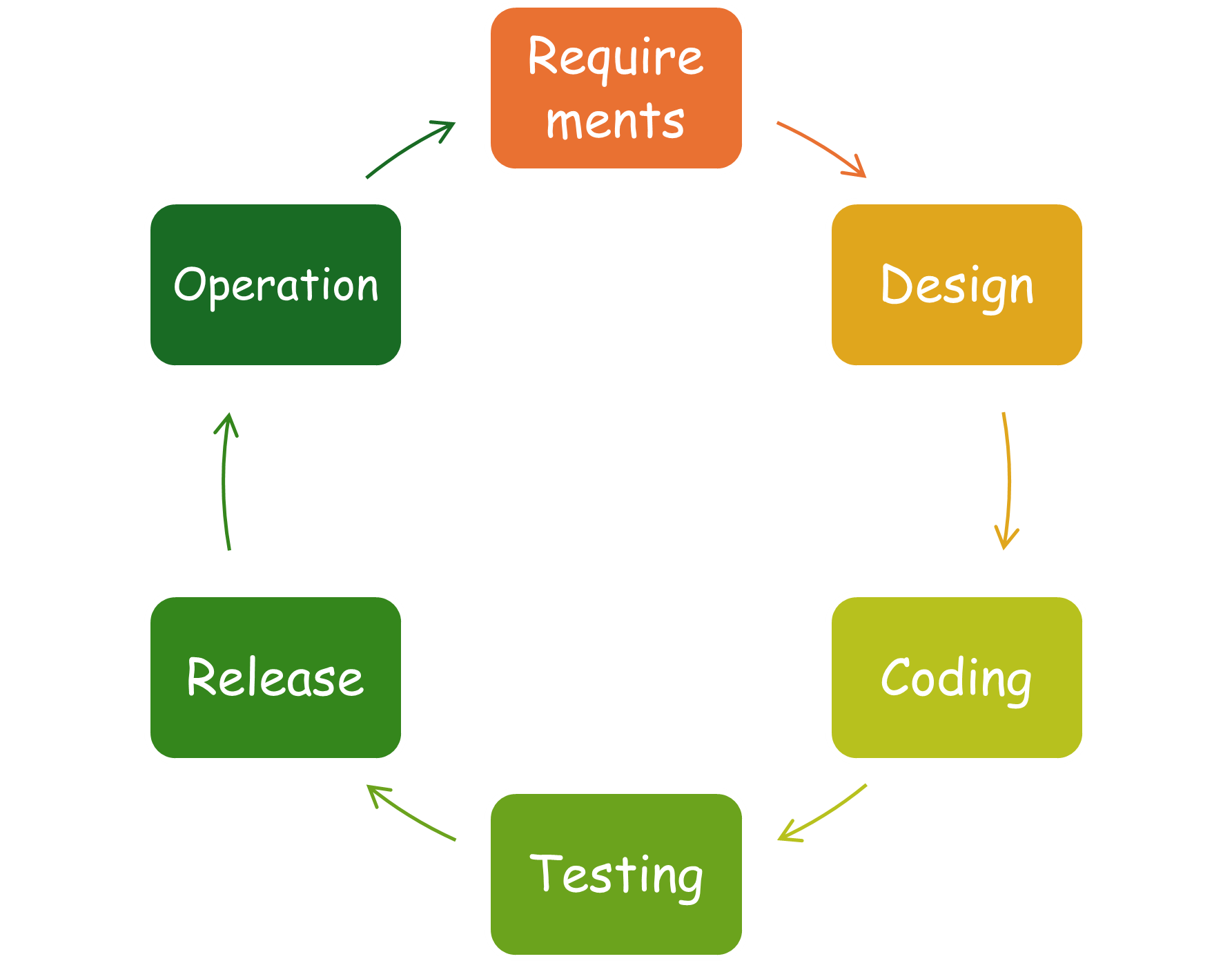
- Code: tokens, AST, call graph, data flow
- Validation: tests, specs
- Natural language: comments, documentations, issues/PRs, logs
- some are readily available in verbatim form (code)
- some need to be extracted by parsing (call graph) or executing (data flow) code
- some need to be connected with other artifacts to make sense (comment-code, test-code)
Code-Related Data
Code-Related Data > Lexing & Parsing > Lexing
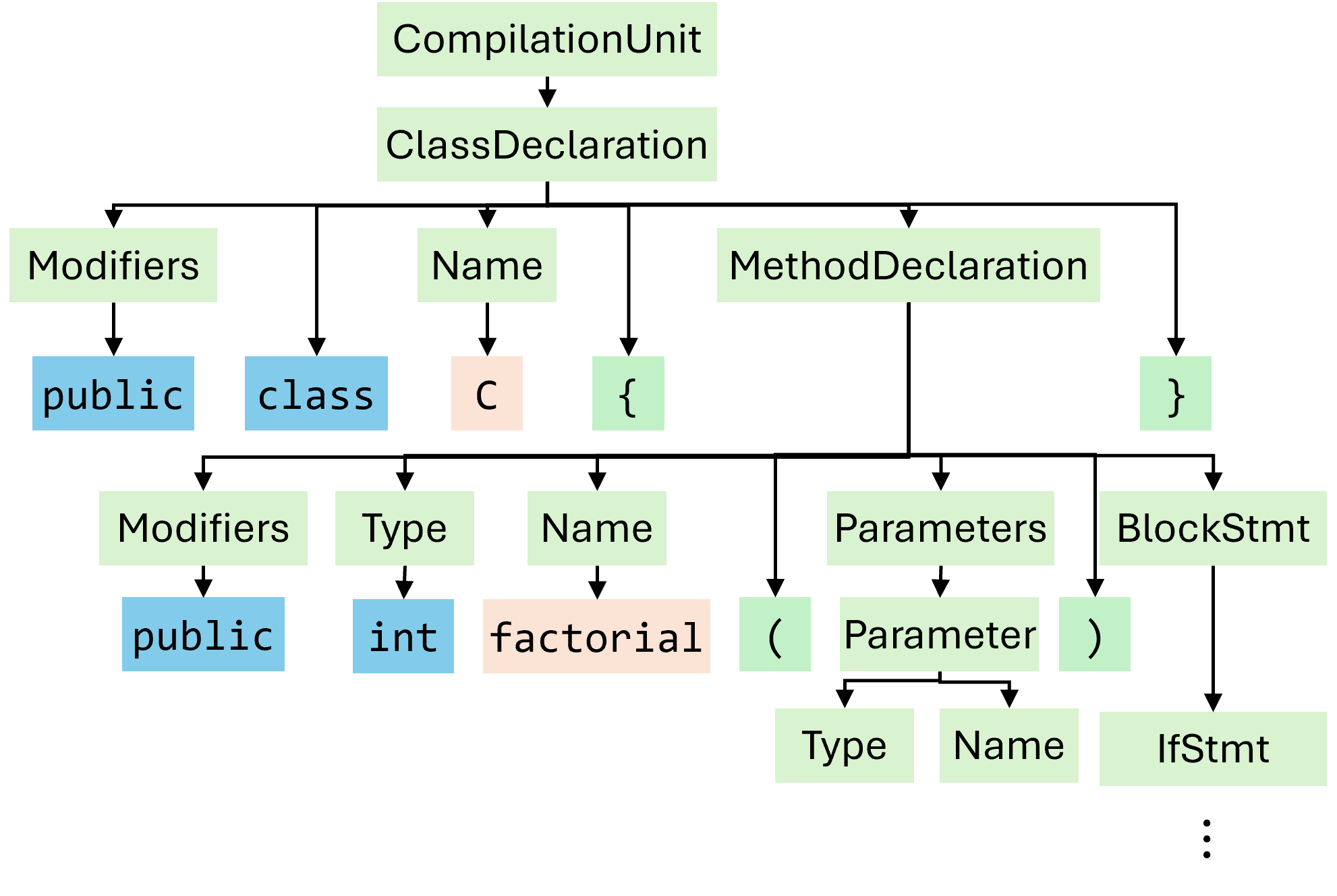
Code-Related Data > Lexing & Parsing > Parsing
public class C {
  public int factorial(int n) {
    if (n > 0) {
      return n * factorial(n - 1);
    } else {
      return 0;
    }
  }
}
The data format used by most static analysis tools, e.g.,
- extract certain code elements (methods, imports)
- connect code elements (method <signature, body, comment>)
- rewrite code by manipulating the AST
Concrete vs. Abstract
- concrete: all tokens explicitly appear as leaf nodes; suitable for manipulation; e.g., antlr
- abstract: omitting keyword and symbol nodes; suitable for analysis; e.g., python ast
Code-Related Data > Lexing & Parsing > Grammar
// lexer rules
IDENTIFIER    : Letter LetterOrDigit* ;
Letter        : [a-zA-Z$_] ;
LetterOrDigit : Letter | [0-9] ;

// parser rules
methodDeclaration
    : typeTypeOrVoid identifier formalParameters
      ('[' ']')* (THROWS qualifiedNameList)? methodBody
    ;
typeTypeOrVoid
    : typeType
    | VOID
    ;
typeType
    : annotation* (classOrInterfaceType | primitiveType)
      (annotation* '[' ']')*
    ;
- A context-free grammar (CFG) is a set of production rules
- Lexer rules produce tokens; parser rules produce tree nodes
Code-Related Data > Lexing & Parsing > Parser Generator
Code-Related Data > Static Analysis
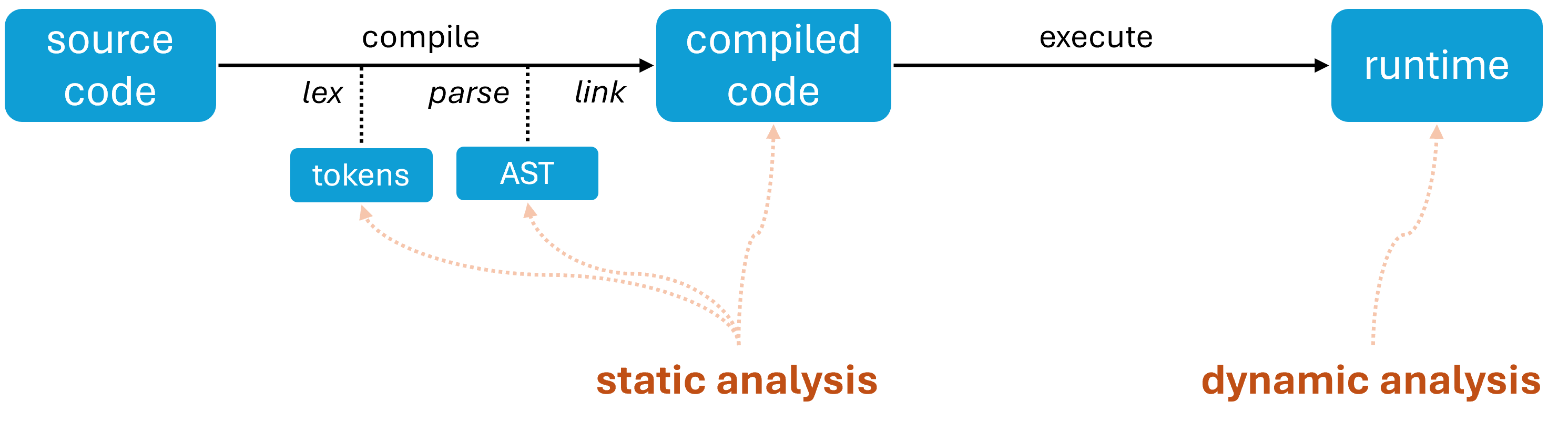
Static = analyze the program without running it.
Kinds of data
- call graph: inter-function dependency; control flow: intra-method dependency
- data flow/def-use: variable dependency; points-to/alias: references to same object
- taint analysis: could sensitive data be leaked to dangerous places?
- type inference: useful for dynamically-typed languages
- symbolic execution / path conditions: logical conditions under which a path executes
Use cases
- input context for ML models (not verbatim code)
- SE tools e.g., linter
Code-Related Data > Static Analysis > Visitor
public int foo(int x, int y) {
  int a = Math.abs(x);
  int b = Math.abs(y);
  if (a == b) {
    return a;
  } else {
    int c = a - b;
    while (a - b > 0) {
      a++;
      b--;
    }
    return a;
  }
}
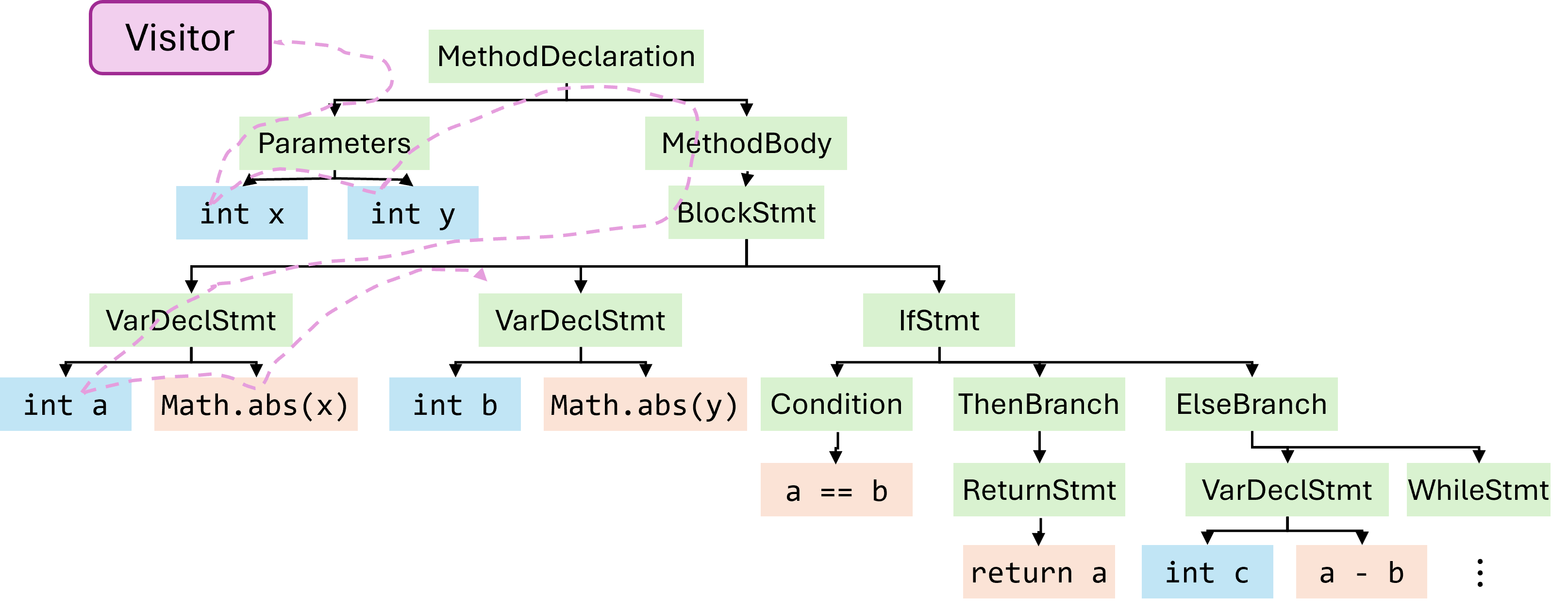
- Most static analysis tools follow a Visitor pattern
- Traverse the AST in certain order (usually depth-first)
- Visit each node once and extract certain information
- Can manipulate the AST if the goal is to rewrite code
- Example: def-use analysis
int x— defxint y— defyint a— defaMath.abs(x)— usex
Code-Related Data > Static Analysis > Bytecode Analysis
- Source-code analysis: based on code/token/AST, close to what developers write
- Bytecode analysis: based on bytecode/IR (e.g., Java bytecode, LLVM IR), close to how code is executed
- the compiler has already done type resolution, macro expansion, optimizations.
- easier to extract some data (e.g., call graphs)
- harder to relate back to source lines
- Tools for Java bytecode analysis: ASM, ByteBuddy
Code-Related Data > Dynamic Analysis
- Dynamic = analyze the program during execution
- usually by instrumenting the program to insert helper code
- Why? Static analysis can be imprecise
- Use cases: (more accurate) context for ML models; coverage, debugger, profiler, etc.
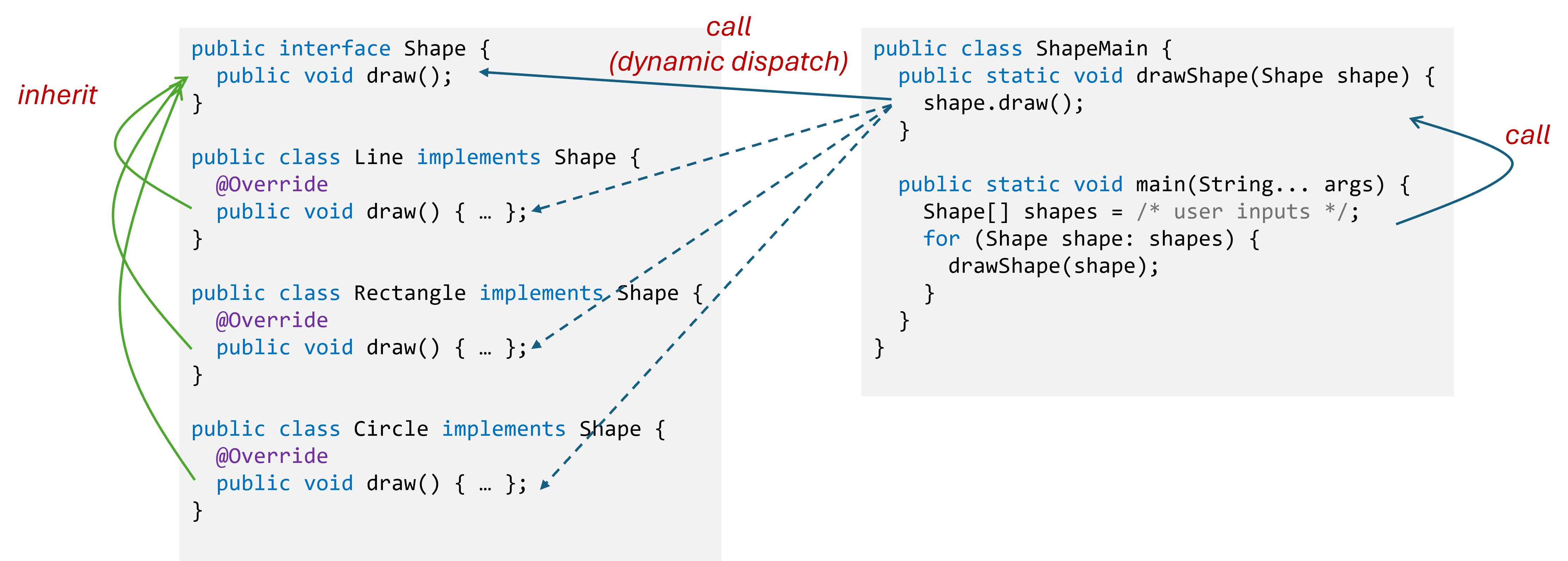
Example: Static call-graph analysis must overestimate when there is dynamic dispatchdrawShape -> {Line.draw, Rectangle.draw, Circle.draw}
Code-Related Data > Dynamic Analysis > Instrumentation
Code-Related Data > Dynamic Analysis > Instrumentation (cont.)
- Where does execution come from? Tests; production (collecting telemetry data)
- Manipulating execution is also possible (e.g., changing variable value in debugger)
- Tools:
- Java: ASM, ByteBuddy, Java Instrumentation API, JVMTI
- Python:
sys.settrace
Other Data
- Validation-related data:
- Tests
- Specs
- Proofs
- Natural language data:
- Comments
- Issues/PRs
- Logs
- Documentation
Validation-Related Data > Tests
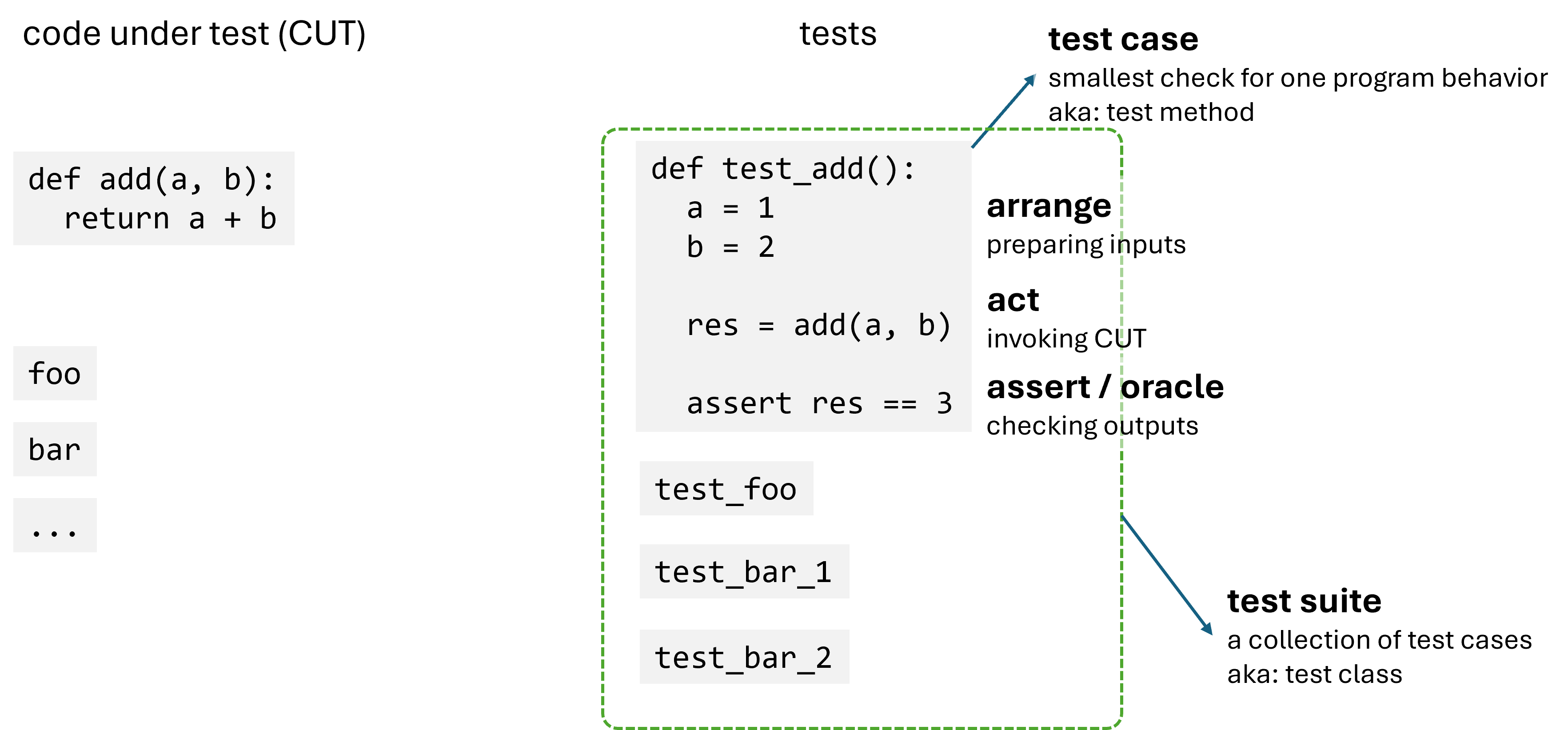
- Tests: executable specification for expected behavior of code
- Regression tests: tests that are executed on every commit to check existing behaviors are not broken by new changes
- Fuzzing / random tests: randomly/systematically generate inputs to exercise the code
Validation-Related Data > Tests > Frameworks & Datasets
| PL | testing frameworks |
|---|---|
| Java | JUnit, TestNG |
| Python | pytest |
| C / C++ | GoogleTest, Catch2 |
| JS / TS | Jest, Vitest, Mocha |
| Go | built-in testing package |
| Rust | built-in cargo test, proptest |
- Test generation from code: Methods2Test, Classes2Test
- Test generation for bug finding: SWT-bench, Defects4J, BugsInPy
- Test evolution: TestEvo-Bench (ours)
Validation-Related Data > Specs
Natural Language Data > Comments
Natural Language Data > Issues & Pull Requests
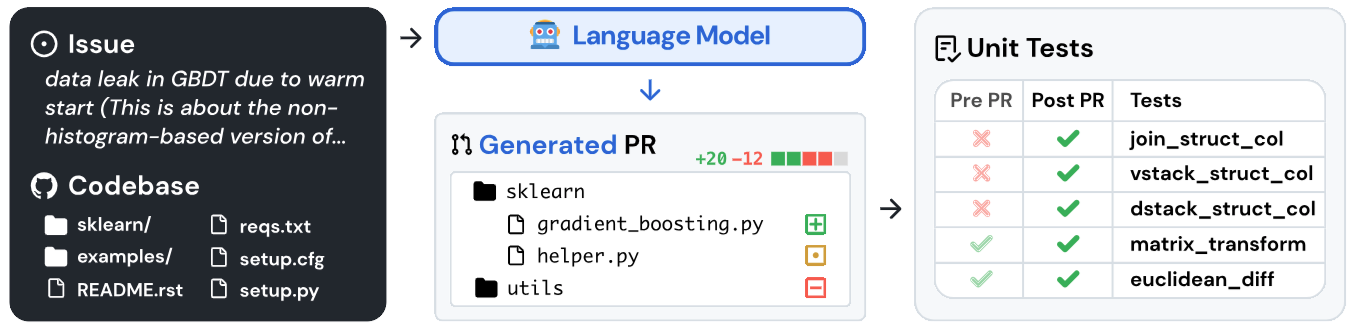
- Issue: bug report, feature request
- Pull request: code changes towards solving an issue, (code, tests, discussion, …)
- Platforms: GitHub, JIRA, Bugzilla
- Mine real-world software development tasks from PRs: SWE-bench
- Related: code review, AI-generated PRs (MSR'26 Mining Challenge)